Showing posts with label Level Design. Show all posts

Tuesday, April 3, 2012

Development Log: DOOM Monthathon #10 - Complete


So I've finished balancing for difficulty, fixed a couple last-minute texture issues (I think there's more, but things will always slip through), zipped up the level and uploaded it.

You can download the level HERE.  You need a .7z extractor, and a copy of DOOM to play it, of course.

For those who cannot play it, here is a video showing the easiest difficulty setting, just so you can get a gist of the level without needing to watch me struggle on it:


On harder difficulties, there are demons wandering through the acid, Barons of Hell at the end instead of imps, and a Cacodemon in the marble hallway and at the end just before you exit.  Beyond that, just more enemies and less pickups.

QUICK POSTMORTEM

What Went Right: Size and Scope

I designed my level quickly and managed to make something that could be completed in the timeframe.  Usually, level ideas are vast in scope and need to be whittled down, but I'm learning to scale down when called for.

Going in, I thought that I would almost certainly design a level far too large, but as I worked I kept the scope down by simplifying and cutting out things that were becoming too big.  This had the added bonus of preventing monotony and repetitive gameplay.

What Went Wrong: Pace of Work

The design and experimentation phase went quickly so I could spend lots of time on building, and after building I had plenty of time for texturing.  However, texturing is always a slow process for me because I just find it to be one of the more boring tasks of building a level.  (In other editors, replacing brushes with models is the equivalent.)

Because of this, work slows down at this point.  What I need to do is work faster at that so I can move on to more fun parts that come later, like enemy and powerup placement, and difficulty testing.

Lesson Learned: Work Hard on Even the Smallest Projects

Usually, my game ideas are massive, and would require the resources of a big studio.  I scaled down my ambitions to make this one level, which essentially amounts to an exercise in level development for me and a way to keep my level muscles in shape.

However, though the project was small and scoped properly for just a month, that doesn't mean I can be leisurely about it.  Because I didn't budget my time appropriately, this project is one post longer than it should be.  Even though I lost a lot of progress when the editor crashed, that's no excuse, and I should have allowed time for such problems to occur, and worked harder before and after the crash.

Friday, March 30, 2012

Development Log: DOOM Monthathon #9


I can't lie; I didn't work on much visually this week.  I added a couple of lights to the storage rooms and a couple of trees to the outdoor area, but beyond that nothing is new in terms of pretty pictures.

"A tree.  Fascinating, Captain."
I have been balancing the easy difficulty setting, however.  I'm making sure the rooms get progressively more difficult, although on easy they should never be tough, exactly.  Even someone who's never played before should be able to get through without dying.  It's much harder to judge the difficulty settings myself, of course, since I know the level too well.

Although this will be my last update in March, I will be doing at least one more dev log on this project, so I can post the final product itself for download and have a video to show.

Tuesday, March 27, 2012

Development Log: DOOM Monthathon #8


As far as building goes, I've finished the last two storage rooms (one of which was simply blocked off, because too many storage rooms were getting far too repetitive, and it was better for pacing that way), and now all that is left is enemy balancing and texturing.

Subconsciously similar to the maze in E1M2, oddly enough.
If you look at the picture above, you'll notice all the crates are beige and the floor is gray (the floor is actually made of crates as well).  So I need to break up the monotony by trying to make non-patterned beige-and-gray crates.  Unfortunately there are only two styles of beige (square and double-wide) and one of gray, so preventing the monotony will be a challenge.  Also, the ceiling needs lighting in the storage rooms.

As far as enemies go, there is a variety between difficulty settings.  The way I think of it, on the easiest setting I should be able to survive without even really thinking; on medium I should have to struggle hard to survive, maybe dying a couple of times, but still being able to kill 100%; and on hard you simply can't kill everything, and have to run past a lot, taking as little damage as possible.


Friday, March 23, 2012

Development Log: DOOM Monthathon #7


Enemies! Woot!
After a while, it gets hard to figure out what I've done since last update, because everything blends together.

The visual is useful after all!
So I've placed a majority of powerups and enemies around the level, including many for different difficulty modes.

Time for imp stomping.
Because it's a short level, I don't think I have the room to introduce too many enemies and powerups, but I think I have plenty of variety so far.

I also spent a lot of time on making the storage rooms have some variety, as well as some platforming challenges.

Easy platforming.
Moderate platforming.
Tough platforming.
I modified the lighting a little, so it's darker in the sewers and brighter outside, but I didn't change it too much overall.

So all I've got left is the two last storage rooms (and I know what I'll do for the big one), and then it's mostly texture refinement and balancing.

Tuesday, March 20, 2012

Development Log: DOOM Monthathon #6


I redid everything I had previously lost, plus some, bringing the level to alpha.

This shouldn't change much anymore.
I know many people have different definitions of 'alpha' so I'll clarify here by saying that alpha means you can get from the beginning to the end, even if there are no bad guys, obstacles, etc.  What needs to be there to complete the level is there and functional (keys, lifts, teleports, etc.).

So I spent much of the time finishing up the last area.

Oh yes, definitely inspiration from Curse of the Catacombs.
This area has the dual purpose of functioning as the final area and the 2nd area (of four), because the first time you visit it, you see it through the bars of the cages, and the second time you are outside.

So close yet so far.
I also changed the location of the red key in the room that changes shape based on what difficulty level you are on, to provide a little extra challenge.

Now that it's at alpha, my next tasks are to add enemies, items, fix textures, and set lighting.  I also need to add boxes to the storage rooms in the sewer.

Freeeeedoooom!

Friday, March 16, 2012

Development Log: DOOM Monthathon #5 - BOOM


Here's a lesson that I have to relearn every single time I start a new project: SAVE ALL THE TIME.


Doom Builder 2 crashed on me, after hours of unsaved work.  When I reloaded it, everything was gone.  I had assumed that doing a test autosaves like other editors I've used (and I was constantly testing to make sure everything looked and worked right), but I was unfortunately completely wrong.  Of course.

This sets me back a bit.  I don't remember everything I've done, but it certainly included the much of the final area, and modifications to the red key area.

So I'll have to redo that and post it next time.

Tuesday, March 13, 2012

Development Log: DOOM Monthathon #4


I finished building the sewer section to alpha, and added a few details to make the section more interesting.

Tripled-sized closets, for all your sewer gardening needs!
There are now many more storage rooms, which I'll use as places for bonus items.

Looks silly now, but I'll think of something more creative later.
I've also added a couple of platforms and ladders that allow the player to climb out of the acid if they fall in.

Behold: the visual that really doesn't explain much.
After the sewers, I worked on the room that changes shape, which you can see in the map above, to the right.  There is a main circular corridor, and all the rest of the rooms are opened by flipping a switch.

You can see what was opened up by the outline on the ceiling, and the door tracks on the walls.
The inspiration for the room is partly from the room where the chainsaw is in E1M5 of the original DOOM, and partly a level from a game called Curse of the Catacombs/Catacomb Armageddon (the greatest game made with the Wolfenstein 3D Engine).

The part with the changing room is actually the third section, and so I'll work on the section between the sewer and that next, which is how you get the yellow key.

I may or may not leave the yellow key there.
I'm thinking of having the teleporter go from the stairwell to an outdoor area which will preview the final area.  The player will probably find himself in a cage like a zoo attraction, although I'm not sure yet, so I'll solidify the idea for the next update.

Friday, March 9, 2012

Development Log: DOOM Monthathon #3


So I've begun building the level.  Normally I would sketch the level on paper first, make a clean (readable) version in Inkscape or similar, and then start with the actual building of the level.

But I've decided to take a different approach.  This time I've decided to only put sketches of individual ideas down on paper, then get right in the editor.  I'm seeing if the drawn maps actually helps with clarity, or if it can be cut out of the process.  Also, since I'm only giving myself a month to do it, I have to get to it quickly.


So I began by working on the main stair room.  I decided the blocking of higher floors was not that necessary, and could be accomplished with locked doors.  Sometimes the more creative approach is just more convoluted.

Then I began worked backwards, creating the sewers, which takes up most of the map shown above.

As I create it, I've decided that teleports will be used sparingly, only to prevent the player from crisscrossing too much.

The player begins in room A.

More boxes in the storage closet to come.
The player finds that the door that's between room A and C (circled) is blocked, so the player must hug the wall and take the long route around to room C, and then emerge on the other wall across from room A.  The player can then reach room B, where the blue key is.

All art placeholder, I promise.
There will also be a teleport in room B to hop back to room C so the player doesn't have to backtrack all the way around Robin Hood's barn.

Next update, I expect that the sewer section should be alpha complete, and I'll start on the next section.

Tuesday, March 6, 2012

Development Log: DOOM Monthathon #2


First, here is the example of blocking progress up the stairs that I mentioned in my last dev log:


I think this works out decently.  I may also find more interesting ways to represent the block, but in any case, it works well enough.  I might also have it simply so that there is no keys, and a switch deep inside the spoke takes care of it, although I think perhaps the satisfaction might be greater if you can watch the stair completing itself.

Anyway, on to new stuff!

Even harder to read than last time! Yay!
I've never been that fond of teleports.  I always thought that, unless they were very simple A->B and B->A, they were more of a frustration than anything else.

Yet, some DOOM levels utilize teleports in greats ways, and Half-Life did a half-decent job, too.

So I decided to push my brain a bit and delve into teleports to see what kinds of interesting things I could do with them.

Certainly, teleports + enemy placement can lead to some very interesting firefights, but in terms of pure navigation, what can a teleport do that a lift or a door can't?

Teleports: Acting like bridges since 1993.
So I've come up with a few ways that I could integrate teleports in a way that takes advantage of their uses.  While I think teleports are ultimately still rather gimmicky, I think I'm going to put a few in my level to spice things up a bit.

I think using teleports as a tease or preview of what's to come can be one effective use.  Also, to get to hard-to-reach items, or even a vantage point to target enemies.


And now that I have a couple of different themes and ideas that are workable, I'll move on to turning these disparate parts into a cohesive level.

Friday, March 2, 2012

Development Log: DOOM Monthathon #1

EDIT: The game is complete.  Download the level HERE (requires .7z extractor and copy of DOOM) to play it before reading everything, so you can play the level without spoilers.  Then read these dev logs to see the process.

Carrying on:

I've come up with a short list of possible themes for my DOOM level.

Chickenscratch, ahoy!
One of the things that has always stuck in my mind for some reason is the idea of making a lift like an elevator -- it can drop you off on many different floors.

So if an elevator is used as a central hub for the level, I could create at least four floors that each could have their own sub theme.

However, testing this idea in the editor was underwhelming.  Sure, it works, but it's not nearly as interesting an idea as anticipated.  It will serve as a hub if necessary.

Visually interesting it is not.  Maybe if I could look up.
But I decided to try a second hub style to see if there was a better way.  So next I tried a circular stair, making a tower or lighthouse-styled hub.

One of the reasons I first made a lift, then a staircase, as the hub is because I want the level to have a sense of verticality.  I remember once on a DOOM mod website, someone said that his biggest complaint with mods is that people rarely use height -- most DOOM mods are pretty flat.

This is kind of a problem because of DOOM's limitations.  You have to be extremely clever to make floors on top of floors, because in general you cannot overlap rooms from a top view, making the height axis a little tough to utilize.  DOOM is not much of a 3D engine in that regard.

I've taken that height advice to heart in all of my FPS level designs, even if they don't have the limitations DOOM has.  I like to give my levels a sense that you are either climbing high or low, such as scaling a mountain or spelunking.

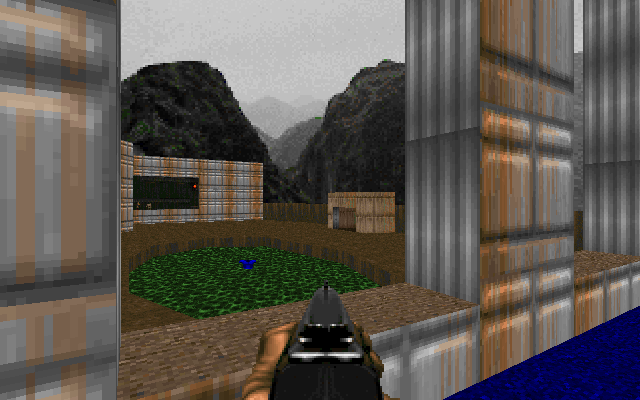
Because the mountain wasn't there, I created it.
Anyway, I think the staircase style is more visually interesting, but traversing it is tedious.  I was considering having the level progress so that the player starts on floor 2, goes down to 1, up to 4, and down to 3 to exit.  However, with a staircase-style, the backtracking and overlap would be annoying.  I can still do that on the lift, but the lift has lost its appeal.

What I may do instead is have the player go up the stairs in a linear fashion, from bottom to top, but block the player's progress up the stairs until they have completed their current floor.  This gives the feeling of upward progress, as well as feeling like they are achieving something in each section, without backtracking.

An awful lot of climbing to do more than once.
After the hub, I experimented with two other themes for sections.

I considered making an area where the player must use radiation suits strategically, where one wrong move can injure them by having the suit run out before they make it to the end of an acid river.

However, each suit lasts about a minute, and that is far, far too long for this kind of test.  Having the suits last for 30 seconds, or 15, would be much better.  I also tried to make a straight line to see how far I could get before the suit ran out, and it was 32768 units (of course!).  The problem with that, however, is that a corridor 32768 units long glitches up the walls.

Heck, even the left side wall is screwed up!
I think that is out.

Next I tried to make a room which would begin small and get larger.  As the player moves through the room, the room goes dark, then the layout changes, and the room lights up again.  I would hope that this would disorient the player, but I think it didn't work as well visually as I had hoped.

It might work better if I change the doors to lifts that stay down, or have a combination, or create a maze that changes its configuration drastically once the player has reached one end (a key).

I like the idea, and haven't given up hope on it yet, but I think it's only the first one that is really cool that I've tested.

I'll try to come up with and test out a couple more ideas before making any commitments.  After the next log, whatever I have I'll stick to, and start building the level in earnest.

Friday, December 23, 2011

Development Log: The Sacrifice - Part III: 1st Half of Level 2


After making an alpha or proof-of-concept of level 1, I decided to dive right into level 2.

To separate the look of each level, I've decided to make each have a certain color scheme and theme.  So while the first level was mostly wood with hints of marble, this level would be mostly marble, with hints of red.
The red being blood and fire.
Level 2 naturally flowed from the idea of ending level 1 in a secret chamber, where imps came out, so I decided to make level 2 a fortress made and run by imps.  The majority of the enemies here are imps, although demons, spectres, and both kinds of humans make appearances.

I am also thinking of making Barons of Hell be the boss of this level, to create a hierarchy of demons that reign in Hell.  Imps are the peasants of Hell, and Barons are, well, the barons.

Since we have a full fortress here, rather than just a church, the level is a lot bigger, and being only about 60% done, it's already much larger than level 1.

Everything so far except the really long stairs, which you can see beginning at the bottom.  If I showed that, there would be no detail in this pic at all.
But then I had to consider, what is it a fortress of?  What could it be protecting, or damming?  I decided upon the storyline that the fortress acts as a gateway between Hell and Earth.

The devil-worshipping cultists, then, while having stumbled upon something great, are still small fries.  Their only connection to Hell is the fortress, and they think Imps are a big deal.

But enough of this backstory; it doesn't come out much so far in the grand scheme of things, especially when you're playing moment-to-moment.

So the player begins by going down a very long stairwell that ends in the main circular hallway of the fortress.  There are bodies at the top of the stairs where previous cultists have gone, only to be killed immediately upon entering the unholy place.

Most of the doors require keys, but one room does not.  It is a dining room.  Or perhaps it is dinner theatre, since two men are standing on a table fighting each other when you enter. 

I pretty much ripped this right out of King's Quest: Mask of Eternity.  I have no shame.
Of course, the place goes nuts when you walk in, and everyone tries to kill you.  My hope is that, if timed right, one of the two men on the table will shoot the other one in the attempt to shoot you, and it will appear as though they were fighting each other all along.  I've been trying to use the AI to the best of my ability to create these set pieces.

Also in the dining room is a body roasting in a pit, on what is the closest DOOM offers to a spit.  This is also right by a pile of bodies, showing that imps use the sacrifices given from above as meals.  There is also a shaft nearby that the player can't see quite yet, and I would like to incorporate the shaft back into the first level, or perhaps the third, so the player can see where the bodies are dumped.

"Sorry, sir, lobster is not on the menu today."
There are also planted trees which are mostly rotten scattered in the walls.

Just past the dining hall is a torture room with a viewing area.  Although there are imps watching the torture show when you walk in the dining hall, the player probably won't see them because they hear the commotion and come running.  I've tried to block the sound so the imps don't notice until you come up to them, but the effect is more cheesy than anything, so I left it with only the implication of a viewing spot.

Although I suppose you need those little binoculars to see from the balcony.
In the torture room there are both demons and humans, all kept in separate cages, except for the center cage where demons and humans have deathmatches.  This also gives off the suggestion that Demons are wild creatures in Hell, not nearly as smart as the humanoid Imps are.

There is a secret chamber in the torture room where confiscated weapons are kept, so the player can stock up.  The torture room is meant more as a bonus area than as a necessary area to go.

There are a few more extra areas that provide some depth to the story.  One is the shaft I mentioned before, where bodies pile up, and the player can reach a previously seen but unreachable armor.

You were supposed to be one of these.
There is also a room that has a couple of imps in it, and a second, smaller room next to it with a chainsaw.  If you look carefully you see papers on a desk.

This is actually the head landscaper's office, and he has both his own planted tree and a few bottles of water (Health pickups) to it.  As well, the walls in the hallway outside his office are crawling with ivy.  I hope that this is obvious, and if not, it at least appears to be an office of some kind.

Even Hell has paperwork.  That's why it's Hell.
Past that hallway is another torture room, but apart from the rowdiness of the main torture room or the dinner theatre is a room for more private affairs, where one or two imps can get up close and personal with their victim.

This room is being renovated, however, with a new tree being planted in the wall.  There is a tree in a pot, and a step ladder to climb up, as well as a couple of imps working to get it in the wall.

Past the tree the player will discover a network of tunnels where Demons and Spectres roam free.  The player can walk behind the walls to see the dining room from a new angle, as well as find a body of a man who was hiding there.

I am considering making the cave system much larger and maze-like, perhaps with bonus detours that can lead the player to some nice loot or cute vignettes.  Perhaps the landscapers have their own little hangout here.

A very very dark cave.  Going for as much of a natural lighting feel as possible.
Eventually beyond the cave system the player will come to a place where a second tree is being planted in another huge hall.  The player can pick up a blue key here, and find his way back to the main circular hallway.

There is also a hall that connects the rectangular hall and the private torture room, with a hidden backpack.  This is the "proper" way to go, but if the player went this way, they would see the blue key and be unable to reach it.

"How do I get up there?"
After coming back to the main hall, the player can use the blue key to open another door, leading to self-immolation chambers which mimic the cultists' similar chambers in the previous level.  This is meant to provide some continuity and show that the cultists get their ideas of Hell straight from this fortress.

This is where I am, at the moment.  I have a whole other section to complete.  I've been trying to come up with some new features that seem fresh and interesting, instead of mirroring the other side of the level.  I am considering keeping with the self-immolation theme and saying that this wing of the fortress is meant for imps to torture themselves.

After that wing, the player will come back out in the rectangular hall again, and back into the circular room.  The player will then be able to open up the center circle and find a throne room which will have a Baron or two, and a red key, which the player will use to get out of the fortress, going back up the stairs the way he came.

Overall, so far, level 2 seems to be working out much better than level 1.  Not just for the detailing and the size, but for the challenge as well, due to the fact that the set pieces don't get in the way of a fair fight.  It's extremely tough, but possible if you have a good strategy, and you don't feel trapped at any point.

Friday, December 16, 2011

Development Log: The Sacrifice - Part II: Level 1 First Draft


Level 1 is a short level that introduces the player to the hub, and gives the player something realistic and earthly before dragging them down into the chaos of Hell.

Since Sacrifice begins in the normal world, and since the hub needs to make sense as a place you would visit over and over, I decided to make the first level be the church that the cultists worship in.  So once out of the sacrificial pit, the player finds the nave of the church with wooden pews and marble altar (and a crucified body on the wall).

Church always seems to fill up from the back.
There is a mass in session, so there is a priest (one of many) giving a sermon at the altar, with the cultists in the pews.  I decided to separate cultists from priests by having normal cultists be pistol-wielding, while priests are shotgun-wielders.

The nave has a front door that requires a yellow key.

Keeping up with the theme of sacrifice, the next corridor beyond the nave has a series of self-mutilation rooms, where individuals cut themselves and pour their blood in basins as an offering to Satan.  In a way, these replace Catholic confessionals, since the cultists would have no need to confess their sins except to gloat, rather than to be forgiven.  The player finds a blue key in one of these chambers to gain access to the next area.

Like shooting fish in a... self-mutilation... barrel...
Next, the player goes up a long staircase to a tower room where the main priest has his office.  On the easiest and medium difficulties, this area remains sane, in that it seems that humans are running the show.  However, on the hard setting, imps make their first appearance here, showing that the resurrection of demons is already a lot closer than you think.

Beyond the tower room, the player winds back down and goes even further until he reaches the catacombs.

The staircases are hidden on the map because I want the player to have the sense of impossible architecture, as though the staircases overlap.  DOOM does not allow this to actually happen, but I thought the spiraling stairs, from the inside, would give off the impression.

The catacombs are in the shape of a ribcage, which the player can see on the map, with the coffins representing the empty spaces between the ribs.  The player enters and exits from the throat.  One coffin has its lid removed, revealing not only a body but the yellow key, which the player needs to open the front door in the nave.  This coffin is where the heart would be in the ribcage.

Ribcage catacombs with the player standing where the heart/key is.  Also you can see most of the level from here, except for the spiral staircases that are hidden from the player.
On medium, the catacombs are the first instance of imps, showing that, while they exist, they do not yet appear to control the cult.

The player must come back up the spiral stairs, through the head priest's office, back down the other stairs, through the corridor with the mutilation chambers, and back to nave, all of which are now crawling with new baddies.

Once the player makes it to the front door, however, I had an interesting time trying to come up with an excuse for why the player can't just leave and be done (besides that it would be a very short game).

So here comes the first instance when things aren't quite right.  The player can see the way out (so it appears), but is blocked by a switch.  I considered making the switch blockade simply a brick wall a la The Matrix when Neo gets déjà vu, and I might go back to that in the end, but I thought it might be a better tease to show that there is the gate right outside but impossible to reach.  Throughout the episode, I will be making a lot of little moments that make the player feel ill-at-ease with the logic of the world, especially considering there is so much order elsewhere.

With the original DOOM levels, the design had no logic to it, so there was no real feeling of unease at things being not-quite-right because everything was not-at-all-right.  So for this mod, I'm trying to at least start off with a solid grounding in reality (this church looks quite a bit like a church), and spice things up with surprises and odd ways to navigate the level, until it eventually becomes flat-out surreal by the end.

So the switch reveals a hidden door behind the altar which leads to the proper exit.  This brings us to the second level, which I am currently working on (I'm about half done).  Since the player is exiting through a hidden door, rather than a more logical exit, the player should wonder what the heck they're getting into.

On the easiest setting, this is where the first imp appears, as a tease of what to expect from the next level.

For each difficulty, I tried to make it seem natural for the enemies to be in the areas they are in, while still being lenient enough to have solid gameplay and great fights.  This has a secondary effect of slightly changing the storyline, which I always want to be careful about.


One of the problems I know I am currently having with this level is that the corridors are too tight and there are few opportunities for cover.  The stairwells aren't bad, because the enemy has the same disadvantage as the player, but the pit, the nave, and the catacombs all suffer from the same problem: you walk into a room and get blasted on all sides.  I'm thinking I'll need some major restructuring to get the set pieces to work for gameplay.  I think they work well visually, and the player can figure out what each room is supposed to be, but it doesn't make for fair fights.

The gameplay video you see is on the easiest difficulty setting, partly because I just want to show the level without too much trouble, and partly because the difficulty gets a little out of control on higher settings.  Sometimes I can't even beat it on "Hey, Not Too Rough", so I'm sure I need to revisit the level architecture to get something with a decent challenge without the player being handicapped by the level design.

Tuesday, December 13, 2011

Development Log: The Sacrifice - Part I: Overview


Sacrifice is a nine-level DOOM mod with a story and level design that works from the broad-strokes overarch to the fine granularity of individual rooms within levels.

The main thrust of the level design is to take the linear level sequence of DOOM and turn it into a hub-and-spoke design.  So levels 1, 3, 5, 7, and 9 will have the player retracing their steps through a central room to get to the next spoke, while levels 2, 4, 6, and 8 require the player to go deep into a level and wind up back at the beginning to exit.

Each level and room should tell its own tale with detailing and enemy placement, as though little vignettes are taking place that the player stumbles upon.  Rather than placing enemies for the sake of obstructing the player, each enemy should have a reason for being in the location that they are in.  This also requires rooms that can serve for three purposes, since different amounts of baddies happen with each difficulty level.

Using the basic theme of Hell inherent in the enemy design and textures of DOOM, Sacrifice takes you down to the depths of Hell and back.  In Sacrifice, you play an infiltrator, gathering intelligence on a cult of Devil-Worshippers by pretending to be one.  You are a low-ranking recruit in their circle, but you hoped to rise in the chain and gain greater access to their secret information.

Before you can, however, you are selected to take part in their sacrificial ritual -- and you are the sacrifice.  You are meant to go down into a pit (so as to be closer to Hell) and shoot yourself in the head, killing yourself, since to the cult, self-sacrifice of life is the ultimate sacrifice, and Satan is pleased by such sacrifices.

This back-story gives the player a reason to start with a gun, which is something I struggled with concocting for the scenario.  It's a little convoluted, I think, and I may change it later.  (After all, it's easy to change back-story when DOOM's back-story itself takes place in the manual.)

I may have the player be a Devil-Worshipper who simply doesn't want to end his life, or changes his mind on the whole thing, or wants to raise the Devil in a different way, or whathaveyou.  Whatever I end up with for player motivations, the scenario all starts off the same: you are in the pit, and you are supposed to shoot yourself, and you decide to climb out and sacrifice some other Devil-Worshippers instead.

So you begin in the sacrificial chamber, at the bottom of the pit (I think of something like that scene from Temple of Doom without the lava).  The sacrificial pit room is the central hub which the player will come back to again and again.

There are five doors leading out of the chamber, though only one opens.  The player will discover, as the game progresses, that red flames around the doors indicate that they cannot be opened yet, green indicate the player may enter, and blue indicate the door has been previously opened.  This shows the player what they have so far accomplished and how much they have left to go in a rough way.

The hub-and-spoke idea, given that DOOM is obviously linear, means that the levels have bits and pieces copy-pasted to provide continuity and appear as hub-and-spoke.

So the Player, at the beginning of level 3, will begin where they left off in level 1, after making a circuit through level 2.  My hope is that this makes the levels appear more seamless than the original DOOM, which, through its map screen between levels, showed individual buildings clearly marked, making the levels themselves as episodic as the game.

Friday, November 25, 2011

Development Log: DOOM Mods


I've always enjoyed making DOOM levels since I first discovered the Doom Construction Kit in Middle School.  I think it was perhaps my first foray into designing and creating actual levels into a computer; before then, I drew level designs on large pieces of paper for a Sonic the Hedgehog sequel.

Probably something where Tails got to be the main character.
DCK was immensely enjoyable, and if anything cemented my desire to be a game designer, that was probably it.  I designed levels small and large, as well as episode-long level sets.

Unfortunately, they have all been lost to time.  When DCK stopped being compatible with later computers, I thought my DOOM design days were over.

It took all the way to the end of college before I decided to look for DCK again, and found a similar program called Doom Builder 2.  Now, to keep my level design sensibilities sharp, I've decided to design DOOM levels again.

Why DOOM?  Why not Unreal or Portal?  Although I could design levels for those, I find the simplicity and restrictions of the older game to be more enjoyable challenges.  I like the idea of trying to create a story out of a completely non-story-driven game, especially by storytelling through level design and gameplay.

My basic philosophy is that the player should generally be able to understand why everything in the level exists.  If they can't, it's not a particularly well-designed level.

Despite the amount of praise I give DOOM in my deconstruction of it, and despite the fact that the levels are awesome gameplay-wise, the buildings simply don't make architectural sense.  I have yet to understand how the Hangar looks like a hangar.

Helicopters ain't gonna land in that muck.
Since I started to get back into the groove of designing DOOM levels at the tail end of college, I've been designing some one-shots and some full-episode mods on and off when I have some free time.

So every once in a while I'll pop a dev log on Scattergamed that discusses a level I've completed, and I'll have it available to download.  Of course, it's not a flash game, so you'll need to have DOOM to run it.  But I'll also try to have plenty of screenshots and possibly video walkthroughs if you can't.

These won't replace the January Engine dev logs, and the January Engine will still be my top priority, but I thought it would be a good chance to show some of my level design through these mods just as I show my programming and gameplay design through the January Engine.