Showing posts with label Article. Show all posts

Tuesday, February 11, 2014

Addiction... and the Reverse

The other day I decided to start a new character in DC Universe Online.  This comes after a recent major game update.  Normally game updates don't change too much in PvE below level 30, which is where I spend most of my time.  This time something different occurred, however.  It was a very minor change, made with very good intentions, but somehow it made me completely lose interest in the game.

The change went like this:

Normally, there are main story missions, and there are side missions.  Side missions can be found throughout the world, by spotting a character with an exclamation point over his head.  This is par for the course for MMORPGs.

The game developers decided to make these side missions replayable.  Not a bad thing in itself; this was to address an issue that some players had dealing with leveling up and finding other ways to boost their experience (races, investigations, collections, and briefings offer loads of experience, but I guess a lot of those are tough to find sometimes).

Again, it's fine that you could replay side missions.  The problem comes in where I can't find an option to turn off the marker for a completed side mission.  Normally, there is an exclamation point on the minimap where the NPC is, as well as an icon above their head, as well as a big white beam of light surrounding them shooting to the heavens so you can see where the NPC is from a distance.  That's all well and good, and is quite helpful, but after I've completed the mission once, that stuff doesn't go away.  It used to, because there was no more reason to have those effects.  But now since all missions are replayable, I don't know what NPCs I've gotten missions from and what ones I haven't without flying up to them and checking every time I spot one.  I don't want to play the side mission over again.  What's the point if I have no trouble leveling up?  It's essentially their answer to grinding, which was a common RPG problem they managed to get around.

Guy grinding an ax
Seriously: not even fun back in the day.
It seems a bit like that's an awfully small thing to get annoyed about.  Maybe it is.  But it's often the small things that can make or break a game.

I have heard an incredible amount of terrible things about the game Flappy Bird, and apparently it is so despised that the creator couldn't deal with the verbal abuse of both critics and other game devs and decided to take the game off the smartphone stores.  It was apparently extremely addictive and no fun at all.  (Disclaimer: I have not played it, this is just what I've read and seen.)

Yet it has also been compared to Helicopter, a classic old-as-the-Internet game that is incredibly fun, yet not terribly addicting, just a good time-waster.

What's the difference between the two that caused Flappy Bird to get so much ire?  Maybe it's the frustration factor: the game is very hard right off the bat.  Maybe it's the control: you have to tap the screen instead of hold down a mouse button.  Maybe it's the obstacles:  Flappy bird basically works with gates, while Helicopter is more like a shifting tunnel.  Minor variations all.  Yet somehow, one of them is addicting and frustrating, while another is the opposite.

The Helicopter Game
Also, way is way more neon than the other.
Sometimes all those little details sound like nitpicks, but on the other hand, having just one hair in your soup is also a "little detail", but people tend to be completely turned off by it.

I've heard before from designers that it's the vision that matters, not the details.  Seems like both those games had the same vision, but one of them lost their way on the details.

Of course vision is important, sure.  Some big ideas are just never going to work.  But when you've got something tried and true, it's the little things that get you.  How many terrible platformers were made for the NES?  They all had an excellent model to go by.  Yet many of them failed because the little details destroyed the game: the jumping controls were just a tad off, the level design was just a bit too frustrating, the lives or hit counter was a bit too stingy...

Back to the Future II on NES
...they forgot to watch the movie it was based off...
It's great to experiment, too.  The bad platformers need to exist so we know what not to do.

And Flappy Bird should have stayed available, I think.  Even though it was mostly derided by critics (and other game devs themselves), it become number one in the smartphone stores.  Why was that?  Some decision was made in the design that made it utterly addicting.

DC Universe online was pretty addicting for me, too.  A lot of MMORPGs are.  It feel like half the mechanics in those games are designed to be addicting.  Yet one little change--seemingly for the better--somehow made things so much worse for me as a player that I don't even feel like playing it ever again.

As far as design goes, I'd never want to compile a giant list of dos and don'ts and try to make a "perfect" game.  That would be pretty absurd.  Games are an art form, and it's pretty hard (certainly at present) to get it down to a science.  But there may be some pretty decent rules to follow, like "don't drop a hair in the soup."

The problem is we still haven't identified what a hair is yet in games.  After so many years, you'd think we'd notice by now.  But I think we're not noticing the hairs, because there's far too much nicotine that covers everything.

A bowl of cigarettes.

Tuesday, November 26, 2013

Positive Feedback Loops

I'm going to go a little left field with this article, starting with a principle of game design and applying it out to websites.

Positive feedback loops sound, well, positive, but they are actually something to avoid in games.  Positive feedback is when a player receives a reward of some sort for completing a challenge, which makes the game a little easier.  On the surface, positive feedback sounds like common sense: of course you should be rewarded for doing a good job.  Lots of games are entirely designed around positive feedback.  Leveling up in an RPG, or getting bigger, badder, better weapons in a shooter.  But in these instances, the positive feedback is also tempered with negative feedback: the game becomes harder, with bigger bad guys, and more of them.  This prevents the positive feedback from becoming a positive feedback loop.

An unchecked positive feedback loop would make the game easier for players who clearly are already successful.  Grinding, in essence, is using positive feedback loops to get ahead and gain rewards for completing the same easy challenges over and over.  Playing the same easy race to come in first and get the same prize money over and over is the racing game equivalent of grinding.  Often, a racing game will only give you the money the first time you beat it, and subsequent times do not yield any prize money.  This gives positive feedback for doing a good job without creating a loop.

There are other rewards that can be given that, by their nature, require no check or balance.  Beating a boss and getting a cutscene for a reward in no way makes the game easier, but it is still a welcome relief to the player.  Achievements (as much as I hate them) also provide positive feedback without creating a loop--as long as the achievement is a trophy or medal or visual effect, and another bonus is not included with it.

I think by now most game designers understand the concept of positive feedback loops, and how to avoid them.  Sometimes they sneak in, because designers are trying to give less-than-stellar players a leg up, while accidentally giving positive feedback loops to great players.  This aspect still has some kinks to work out, but overall I don't see many games with horrendous positive feedback loops.

To me, the bigger issue is applying this knowledge out into other areas.  Positive feedback loops do need to be avoided, and there are quite a few websites that mess these up.

Let's take YouTube as an example.  Suggestions are oftentimes part of horrible positive feedback loop.  For instance, once, a number of months ago, I watched an episode of Nostalgia Critic or something related to it on YouTube.  I normally watch Nostalgia Critic on thatguywiththeglasses.com, which is their official site, and they host their videos through blip.tv, so the only way YouTube should know I like Nostalgia Critic is through the instance.  Several months later, half of my suggestions are still Nostalgia Critic episodes.

The other half of my suggestions are music videos, because I occasionally look up music through YouTube.

All of my subscriptions are science-based shows, like SciShow and MinutePhysics, so all of my suggested channels are science-based channels, or channels that hover around the VLog brothers (Hank Green is the host of SciShow).

John & Hank Green
These guys are awesome, but I don't need to worship them, YouTube.
So I get three kinds of suggestions, but all are based on things which I already am satisfied with.  When I want to listen to a piece of music, I search for it.  When I want to watch a science-based video, I check my subscriptions.  And I never want to watch Nostalgia Critic on YouTube anyway, I go to their appropriate site for that.

What I would like from YouTube suggestions is new content.  Since Google (owners of YouTube) is a trend-finding machine, they probably can see an overlap between viewers of science-based shows and other types of shows.  Maybe 25% of science show viewers also like political shows, for instance.  I may not like political shows, but there is a decent chance I will.

Instead, I'm stuck in a positive feedback loop with Youtube content.  I've proven to them I like three types of shows, so my reward is more of the same.  And if I watch those, I get rewarded with more of the same, and more of the same, and it never ends, keeping me in a loop, rather than expanding my horizons.

John & Hank Green again, same pic.
YouTube suggested you look at this same picture again.
A great example of using positive feedback, however, is Pandora.  Pandora is a music service that offers you new music to go with what you already like.  So when I type in a band name and create a new station, I'm sometimes given that band, but I am also given other bands that have similar sounds, or are even only tangentially related.  When I give positive feedback about a song I like on the station, it uses that information to expand my horizons even further.  Instead of assuming I'm liking the song because it's by a particular artist, it deconstructs the song and then asks me to listen to music with a few similar parts.

So it uses positive feedback to challenge my music tastes.  It never gives me something ridiculously out there that is over my head, but it slowly introduces new sounds for me to get used to and learn to enjoy (or gives me new music I already enjoy but never knew I did).

Red Hot Chili Peppers album cover
The only thing I don't quite get about Pandora is that is seems to think Red Hot Chili Peppers goes with everything.
When a game has a positive feedback loop, it makes the game boring.  When a website has a positive feedback loop, it insulates the user from challenge, whether it's challenging tastes, or viewpoint, and creates an echo chamber, which can become dangerous.  Heck, this expands to everything:  Mitt Romney thought he could not possibly lose the last US presidential election.  He was stuck in a positive feedback loop and became insulated from alternative voices, so his worldview was not challenged.

But I digress.

I found it rather weird that Google wants to give "personal" results, both in the search engine, and in YouTube comments now (and possibly other places I don't know about).  Personal results seem to be a positive feedback loop that does nothing but damage the experience for the user.

Google/YouTube is just one example of many, of course.  Website designers, social media designers, etc. need to watch out for positive feedback loops just as much as game designers do.  Perhaps even more so.  Because a positive feedback loop in a game only ruins one game.  A positive feedback loop in other aspects of life can ruin a mind.

Friday, October 4, 2013

Sustainable Gameplay

There are some games that never get old, and I can go back to again and again, and my only wish is that they were longer.  I think I'd still play any early Tony Hawk game (keyword 'early') if one was handed to me, and I regret getting rid of some of those discs.

Turn back! Turn back! You've gone too far!
Other games are perfect or near-perfect in how long they last: the gameplay is interesting and fun 'til just after the end, so you never get bored throughout, but you don't clamor for more; you just feel satisfied from a great game experience.  I think Super Mario Bros. is like that.  If you beat the game by warping, you don't quite feel completely satisfied, so you re-challenge yourself to beat the game by completing all 32 levels.  After that you feel like "Yes, that was quite enjoyable, but I'm done now."  Really no need to beat the second run through that becomes available with different enemies, I assure you.

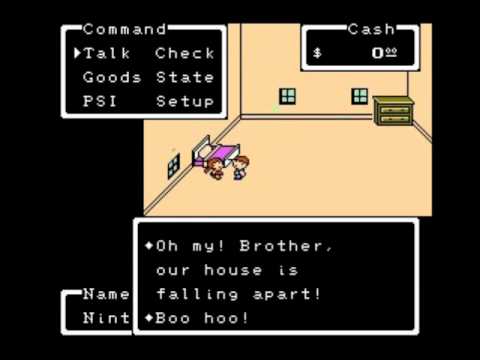
Then there are other games that you give up on, because the gameplay was interesting and fun at first, but it overstayed its welcome.  This is a line hard to describe, since everyone has their own opinion on what games are too long.  But I think for me, often RPGs are too long considering their gameplay.  I remember playing Earthbound Zero (Mother) and getting around 95% of the way through before simply giving up.  Not because I died or it became too challenging or frustrating, but simply because the grind got boring.  The gameplay was fun and enjoyable, but it just didn't go barely far enough to be interesting to the end of the game.  If the game were only 5% shorter (no story changes, just shrink a few levels), I would have finished it and been satisfied.  I was interested in the story, too, but my desire to finish the story did not override the plodding gameplay.

I'm pretty sure I never figured out why my house was haunted.
And it's a fine line to cross.  I'm sure many people thought Earthbound Zero was great, espcially RPG diehards (as a generalist who enjoys almost any genre, I'm not the target audience for RPGs, and find that most of them overstay their welcome). I've also heard the tired argument that "It's about the story, not the gameplay" in RPGs.  Sure, story can take precedence over gameplay, I have no problem with that; but gameplay should not undermine the desire to even finish the story.

And it's hard sometimes to determine, from a conceptual standpoint, how long the gameplay will last for the target audience.  You might have a great mechanic that's enjoyable for fifty hours, but you have no way of knowing that until far into the development process, and your game is expected to take about sixty hours for the average player to complete.  Well, you just got hosed, and it was hard to determine that without an extreme amount of testing before making all those assets.

One way to get it right is to betatest, getting gamers who have never played the game to go from start to finish and use their feedback to determine if the game is too long or too short (the former sin being far worse than the latter).

Too short, but I'm okay with that.
The other option that was a fad for a while (and is it still a fad? I hope not) was to incorporate minigames to break up the main gameplay.  I remember Final Fantasy VII had a kind of tower defense minigame on a mountain (before the concept of tower defense was even a thing; oh, that hipster Square).  Tony Hawk's Pro Skater 4 added baseball, tennis, and other nonsense.  The problem with these is their very intended purpose: to break up the gameplay.  They feel jarring and hurt the overall experience.  Sure, they make the player want the normal gameplay back, but only because they were given a diversion that was far worse.

Thankfully, I haven't seen that happen too much anymore, and when it does, it's a much smoother transition that works within the game so you hardly notice you're doing anything different.  Something like the pegasus rides in God of War II might be an example, since you're still doing approximately the same thing you did on land (kill things), so it's not a total departure.

The other way that most games prefer to do things is to introduce new mechanics throughout the main game that enhance gameplay.  In RPGs, you get new skills, items, spells, etc.  In first-person shooters, you get new kinds of weapons.

But sometimes I feel like that's just delaying the inevitable.  If the core mechanics constantly need something new to perk it up, it's just slapping one band-aid on top of another.  I've played too many games where the gameplay has just started to get boring, then a new weapon appears like a deus ex machina to rescue the game for another ten minutes.

Some games do new mechanics well, adding new dimensions of gameplay without overshadowing the original gameplay.  But that works because the gameplay without the new mechanic is still fun and interesting by itself.  Take, say, Mario 64.  Before you get any caps, the game is awesome, and when you start to get caps, it opens up new possibilities and locations you couldn't reach before, provides new challenges, and adds significantly to the experience.  Yet it also does a great job balancing these mechanics, by making caps a rare thing to get.  Only certain blocks give them to you, and they only last for a limited amount of time.  The caps don't overstay their welcome, and the gameplay without them doesn't get diminished after their discovery.

There is a preponderance of upgrades in games these days, I think.  Seems like too many games give you a new upgrade or weapon or ability every five minutes, as if you're a baby and each mechanic is a bigger set of keys being jangled in front of your face.  At some point, the keys get too loud and bright and you get overload.  And let's stop this metaphor before it becomes stupid.

Anyway, I often feel that these upgrades try to distract a player from bad gameplay by making it addictive instead.  You want to know what you'll get next, even though you don't enjoy playing the game in the first place.  If you think about Super Mario Bros. again, there are three upgrades you can get: the mushroom, the flower, and the star.  All three are introduced in the first level, so you know what to expect, and they become a standard part of gameplay that you work hard to keep from losing.  But you don't get a new upgrade in the middle of the game that significantly changes the gameplay.  I think it would be quite damaging to the game if you had to wait until world four to get your first fire flower.

I remember Manhunt, that game where you sneak up on people and kill them in all sorts of delightfully gory ways.  There is a point in the game where you operate a magnetic crane with a fridge on it, so you can whack bad guys around.  I thought it was a funny diversion for a couple minutes, but then it lasted just a little extra too long so I wanted to get the heck out of the crane so I could play the main game again.  It was a minigame that was funny at first but overstayed its welcome.

Then came the point where you stop sneaking around and the game turns into a shooter.  I turned the game off.  That completely changes the gameplay and it wasn't the game I paid for and was promised.  But I see why they did it: the sneaky killing was getting boring.  Well, instead of changing the gameplay completely, they should have just shortened the game.  I would have been perfectly satisfied if the game ended just a hair before the mechanics got boring, so there would be no need for gunfights.

So it wouldn't devolve into every other game ever made.
True, the game would have been short compared to other games, but it would have been exactly the length it needed to be.

I think there is this idea that games need to be extremely long to be worth the price, but what's that maxim? "Quality over quantity."  I think the mechanics of a game should determine how long the game lasts, and nothing else.  If the story needs more gametime, then perhaps the story should belong in a game with gameplay that is interesting for a longer amount of time.

And then there are the games I mentioned right at the beginning, games which seemingly never get old.  The gameplay is just so good that you'll be happy to play the game until you upgrade your console or computer and it no longer works.  And these games certainly do exist; take any successful multiplayer game.  All the infrastructure required, the servers and support teams, bank on the gameplay being so good it's worth all that cost.

But perfect gameplay for single-player doesn't translate to perfect gameplay for multiplayer, so it becomes an even trickier puzzle to solve.  But I think that's for another article.

What we can say is that this does not work for multiplayer.

Tuesday, July 9, 2013

Infinite Beginnings

When I play MMORPGs, I make a new character and get plopped into a pre-chosen location to begin my journey.  In Tera Rising, everyone starts in the same place.  In Dragon Nest, there are two places to start, depending on your class.  In DC Universe Online, you get six starting locations, based on your chosen mentor.  In World of Warcraft, each race has a separate starting location, giving thirteen total options.  As much as I retch when I say this, WoW wins for variety.

Pandaren in WoW
Also: Pandas.  No other MMO has Pandas.
And a variety of starting locations is needed for MMOs and similar genres, because players are constantly making new characters and starting fresh, and the player may not want to see the same thing or go on the same journey every time.  And if they do want things to be the same, they can make a similar character.

But beyond the beginning, unfortunately, all of these games combine.  In Dragon Nest, for instance, it doesn't matter what class you pick, because by the time you get to level 10, you're following a story and quest structure that's identical to every other class.  Even WoW is guilty of this (despite it's thirteen starts), though much less so:  Trolls and Orcs, for instance, combine together once the player reaches the first city, as do Dwarves and Gnomes (I don't know beyond level 20, but I imagine that more races combine over time).

Yet oftentimes I feel that the content for unique character customization is far superior to storyline customization.  The first few times the player creates a character, they may feel that they are getting something unique... until they reach a point where their last character had been.

Now, I don't begrudge any game for being linear or having a linear story, since some of my favorite games are just that.  No one expects to pop in God of War, start up a game, and have Kratos appear in Egypt.  It's a linear story about a specific character, and his journey does not change, so a player restarting the game shouldn't expect to have a different experience.

But games that are heavy on customization, like MMOs, are trying their best to make the player feel like the game was made just for them, that they are an individual and are going on an epic quest that no one else has ever (or will ever) go on.  And surprisingly, thirteen distinct starting locations still isn't enough variety.

At least, not when it's predictable.

I've mentioned in an earlier article how MMOs can suffer from cloning because their is not enough variety is character customization, or in armor, etc.  But this is also very true for story.  If I know another player is experiencing an identical story, I don't feel like a hero anymore.  There is enough space between me and another player if I'm playing God of War, since I don't have to physically see another Kratos running around, but when I see another player completing identical quests (the worst offense is watching them kill a boss and waiting for it to respawn), I feel like a cog.

I think there are ways to fix this, and none-too-difficult, either.  Take a look at WoW, for instance:  there are clearly defined Alliance and Horde cities, where all races come together.  So let's take Alliance, just for kicks.  If you are Human, you start in a completely human area.  If you are Dwarf or Gnome or Night Elf, ditto.  They all start in areas where all players and NPCs are the same race as the player.

But if cities exist where all races join together, why should picking my race determine my starting spot?  It's not like choosing to be a Dwarf means I am born from a specific hole in the ground and by my nature I have to start there.  I could start in any Alliance city, outpost, village, etc., as long as those areas were set up for tutorial bits, and as long as the enemies weren't overpowering to a level 1 character.

The latter problem is easy enough to solve:  there is no reason today to have statically-stated (stat-ed? statted?) enemies.  Three words: dynamic difficulty adjustment.  MMOs use this concept already for PvP.  Players have their levels raised or lowered to average out teams and put everyone on equal footing.  This can be done in PvE environments, too.  A player who is level 1 might attack an enemy that appears to be level 1 to it, and deal out the appropriate damage, while a player who is level 10 looking at the very same enemy will see a level 10 beast.  And those two players can fight side by side, seeing the stats that match them.  This isn't impossible; it might not be the easiest thing to program, but the principle is there both in MMO PvP, as well as in games like America's Army where players see different things depending on their own circumstances.

The slightly less technical problem is the one of player tutorials being everywhere.  This however, doesn't need to happen nearly as much as you'd think.

WoW Training Dummy
NOT NECESSARY.
Almost every stinking game I've played has a section where you have to test your first spell or skill on a training dummy, and there's no reason for it.  Half of the MMORPGs I've played also suffer from Glorified Exterminator Syndrome at low levels, where the player has to just go out and kill 20 rats.  Half of this nonsense can be eliminated.  Even if you are brand new to the world of MMOs, you don't need that much hand-holding.  "Click to attack, press the number keys for special stuff" is basically a combat tutorial for 90% of MMORPGs.  The tricky things for MMORPGs are those oddly specific mechanics like crafting which a non-gamer might not readily understand.  But everyone can understand "click on the enemy to kill them."

But, let's suppose for the sake of argument that we really do need those early tutorials.  Do it basically the way DCUO does it:  the tutorial sequence is the same for everyone, and then the player gets placed in their individual starting location after the first ten minutes.  It's not ideal, but it's an example to go by.  And if that must be done, making it skippable would be better.  No need for hand-holding the fifth time you play.

The opening level of a game has always been regarded as the most important, just as much as the opening chapter of a novel or opening scene of a movie.  In each case, it's to grab the audience and make them want to continue playing/reading/watching.  Games have an additional reason:  it's the part that's going to be played the most.  It needs to be good enough that it can withstand being played over twice as much as the rest of the game.

Multiple starting points fixes that, to some degree, but players do blast through them all if there's only a handful (and the most I've seen is only thirteen).  But if the entire game world were an option, with every town or city or outpost or any civilized area at all, the number of options would rise exponentially.

Then a player who makes a new character will certainly never get bored, and we can finally say they'll never play the same game twice.

Friday, July 5, 2013

There's Something About Adventure Games

There is something beautiful about Adventure games.  MYST-style, that is: first-person, puzzle-based, surrealistic, thought-provoking, mind-bending.  Of course, I call it "MYST-style", but I think that's kind of like calling an FPS a "DOOM clone".  That was true once, but they've come into their own, and though they appear to be oddly specific on the surface, the paradigm allows for infinite variety.

There is the MYST series, of course, and others of its time like The 7th Guest games (a slightly different take, but within the mold).  And after that, of course, Adventure games died--but this article is not a history lesson.

So let's zip to the present, where there is a light resurgence of Adventure games.  Often they're in the guise of another kind of game, such as Platformers, or mixed half-and-half (or worse proportions) with other genres, like Action.  Pure first-person puzzle-Adventure has become exclusive to casual games, and there are too many awful ones (if it labels itself as an "Escape the Room" game, odds are you want to skip it), so searching for a diamond in the rough is quite a task.

There are great Adventure game developers, like Mateusz Skutnik, as I've mentioned before, with his Daymare series, though his Submachine series is even better.  But unfortunately the list of quality Adventure devs is quite small.

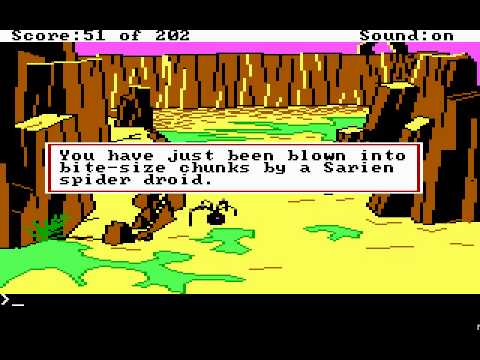
What happened to Adventure games?  There seems to be this constant complaint that games these days are too violent (they've been violent since Spacewar! in 1962, so knock it off with the "these days" nonsense), and violence creeps into practically every genre.  Too often, my search for a puzzle platformer leads me to a puzzle platformer with guns.  Adventure games are rarely violent, partly because they don't lend themselves to violence well.  Violence tends to be a quick, think-on-your-feet kind of action, while Adventure games are designed around thoughtful, drawn-out decisions and contemplations.  I've played Adventure games with violence, but I have found the violent sequences to be almost universally quick, actiony challenges that quite break the flow of the game.

Space Quest spider part
Games where you have to type are not meant for action... Note to self...
I don't quite know what the demand is for Adventure games.  The big industry doesn't seem to care, so Adventure games have become an indie thing.  But hey, if games these days are too violent, bring back the Adventure games, and have yourself a ball...

I think the death of Adventure games was also partly because it was thought that anybody could make them.  MYST's puzzles were extremely difficult, but they were also fair, and quite clever.  I think Adventure game makers jumped on the "extremely difficult" part, but forgot about the "fair" and the "quite clever" bits.  You can still see this, not just with older Adventure games that left no mark, but also in today's casual Escape-the-Rooms, where the puzzle might make no sense ("Of course you have to take the light bulb out of the fixture to unlock the door!  Why didn't I think of that before?").

The other trick of a great Adventure game is surrealism.  Even a game that takes place in a "normal" house (The 7th Guest, for instance) is very surreal.  In most games, the art of a game is a given, and beautiful vistas are not taken into consideration.  Although a player might have their jaw drop when they enter a new area (and I hope all developers strive for that), their mouth shuts when they need to shoot something.

But with Adventure games, that feeling of awe should happen with almost every click of the mouse.  Every time the player sees a new screen or solves a puzzle, something striking should happen.  I just finished playing an Escape-the-Room game that took place in an apartment.  There was nothing interesting to see.  There were probably a dozen puzzles to be solved in the room (or even more), but each one only achieved an unlocking of a drawer or a safe in the wall.  There was nothing impressive about it.

Yet even a beautiful, surreal world follows logic, and the combination of the two can trip up a designer.  It can follow its own logic, to some degree, but it must make sense in the context of the game.  MYST's world used books as a mode of teleportation, and this concept was introduced at the very beginning of the game.  Everything else that followed was a beautiful screen with a completely logical puzzle.  You never needed to drown a fish to unlock a door.

There was a game called Juggernaut for the Playstation (full disclosure:  it was panned, but I loved it) which took place inside the mind of the player character's girlfriend.  Since it took place basically in the imagination, anything could happen.  Yet the designers did not give into that temptation, and instead made each puzzle completely logical within the context of the incredibly surreal world.  You needed to do illogical things like paint a door to make it take you somewhere else, but before you tried to solve that puzzle, you understood that that was something that could happen in this world, so you went along with it.

The key to making a great Adventure game is to understand the opposing forces of the medium:  a logical surreality that, like all videogames should do, is challenging but solvable.  A player should never need to guess at the solution to a puzzle, but they should have to think about it for a bit.  It's the "Aha!" moment that drives the Adventure gamer.  Too often that moment is non-existent in a game, and that's why it fails.

The third, perhaps equally important piece of an Adventure game lies in the convergence of story and puzzle.  Each puzzle exists for a reason, and can't be there arbitrarily.  In MYST, Atrus created many of the puzzles to keep his sons from getting into the books behind them.  They are not just logical puzzles, but logically existent.  The Escape-the-Room game I played recently had no reason for the puzzles to exist in the first place.  Why am I locked in this apartment?  Who would go through all this trouble to hide all these keys around, create all these puzzles?  No one, really.

Adventure games, all told, are much more difficult to create than most casual gaming mills think.  This is probably why they died:  there were too many terrible ones, not because they were hastily slapped together like many of today's, but because making a passable Adventure game is much tougher than it seems.  When one genre grows in popularity, it suffers from too many copycats that don't know what they're doing.

After the boom and bust of Adventure games in the 1990's, they went on hiatus for a while, or got subsumed in other genres.  But now it seems there is more interest in the genre in the indie scene, and although there is a lot of rough, there are a few diamonds, if you know where to look.

Saturday, April 13, 2013

The arguments of "always on" and "the end of single-player"

Growing up, I lived in the middle of nowhere.  My closest friend lived miles away.  We got dial-up internet (eventually), but we could never quite get DOOM working multiplayer.

For most of my childhood, I played exclusively single-player games.  Or, if the game featured multiplayer, it was rarely used.  I think I played Super Mario Bros. on two-player mode by myself just to have double the chances of winning.

I moved away from there and got cable, and now I do like playing MMOs.

But that town I grew up in still only has dial-up, even in 2013.  You can't even get DSL there.

But my early childhood is what got me into games.  If I lived somewhere else, I would probably have friends closer by, and I'd see them more and play outside more.  The isolation drove me to games.

It also got me so interested in games I was drawing level designs when I was seven.

So, with this background in mind, I think it's fairly obvious what my opinion is on the two major debates: the "always on" controversy and the supposed death of single-player.

Single-player won't die, just as books won't die.  Reading is a solitary experience (unless you're reading to kids or something), and books haven't disappeared for the sake of being social.  Single-player remains supreme in the realm of story-driven immersion, because you don't get distracted by other humans acting out-of-character in the world.

Single-player may take a backseat in many genres (and already has in a few), but it will never truly go away.  It will remain the staple for horror games, for instance (and the debate over whether horror games are dying is for another post), for obvious reasons.

I think there will still certainly be a bigger rise in multiplayer-only games, until there reaches some kind of new balance.  But just because the balance is shifting, it doesn't mean single-player will topple completely.

In fact, I suspect there may be an ebb and flow to it, and video games are just too young of a medium to have seen it yet.  Perhaps in fifty years single-player games will be huge again, and it will cycle.

As for "always on", I can assure you that people will decide with their wallets.  I, for one, will never buy an always-on console, until the town I grew up in gets solid and stable twenty-first century internet.  

Amish
Maybe when these guys get internet, always-on will be a good idea.
When it does, I will know the technology has advanced enough that always-on won't be a problem.  Well, technologically anyway.  There are plenty of other reasons to object to always-on consoles.

But I would say that the industry, as a whole, seems to be blinded by its own momentum.  It's rolling along thinking it rules the road, but in reality their are turns it just isn't seeing.

The two arguments about the death of single-player and always-on consoles are just two of many examples where the industry is blasting ahead without stopping to think about who really rules the road--the players who make purchases.  The industry is just along for the ride.

Players will be applying the brakes soon enough on these arguments.  The question is: how many companies will get into crashes before they do?

Tuesday, April 9, 2013

An Experiment in Gaming Quality


Well, time to try to answer that age-old question: were games back in the day better than the games today?

First, of course, let's note potential biases, so we can try to avoid them and answer the (highly subjective) question more objectively.

There are two biases that are in favor of old games from the get-go:

First is your basic nostalgia.  You still like playing old games because you used to like them, and they remind you of a particular time in your life.  This is a difficult bias to get over, and really, the only way to do so is to ignore any old game that you have any affection for.

My example would be the King's Quest series.  I played King's Quest 1 and 2 when I was a kid, on a Tandy computer.  Now, consider that King's Quest 3 is essentially the same idea, it should be essentially the same quality.  But since I didn't grow up with KQ3, when I play it now, I don't really like it.  I may conclude from this that my mist of nostalgia is getting in the way of objectively rating KQ 1 and 2.

But, of course, ignoring the games you grew up with can get you into trouble, because you might be skipping the best of the best, the games which everyone had precisely because they were the highest quality that era had to offer.  So by ignoring games you feel nostalgia for is likely to lower the average quality of the era by default.

SMB3
Ignoring this one brings the class average down significantly.
Hopefully there are some old games that are considered classics that you never got around to, or never had the opportunity to play, and those would help in the testing.  For instance, I never played any Metroid games growing up, and those are typically high-quality games, so playing an old Metroid game, for me, might be a good way to find a high quality game unmarred by nostalgia.

The second bias is the "Oldies Station Effect".  This is the idea that arises from music radio that applies very well to any medium with a backlog.  The example is that an oldies station doesn't play every song that was popular in the fifties, but it picks out the songs which were popular then and still sound good now.  If there was some crummy song that was popular for a week, you aren't likely to remember it, and the oldies station isn't likely to play it.

But a modern station doesn't just play the best of this decade.  Instead, it picks a genre, and plays anything and everything that's selling at all.  Some artists that are popular now will appear to be one-hit wonders in the future, or may fade away entirely.

Pitbull, the rapper
Ahem.
So if you think about old games, you're limiting your field of view to only the games we remember, only the games we call "the classics".  Meanwhile, we are flooded with so many games today, both good and bad, that we might compare the average of today with the best of yesterday.

So to overcome this bias, perhaps we can only weed through today's games and compare the best of today with the classics of yesterday... as long as we're not nostalgic for them.

However, there are biases on the other side, too:

Some games might be our flavor of the week, and because it's so new to us, we think it's great.  We don't have any historical perspective on it, so the game might just be a flash in the pan, to be forgotten as soon as you get your next game.

So though we want to compare new games, we cannot necessarily use games that have just come out, but must use games that have been on the market for a time now and have proven success (or failure).

The other, far more obvious bias, is to suggest that newer games are better by default, because the technology is better, and/or because the industry has evolved to the point where developers have games down to a science.

Newest Sim City
I think we all now the previous statement is false.
Now that these biases are known, can we compare old games to new ones in a more objective manner?  Depends on how well you can get through these biases.  Some of them are tough to get over, because our natural inclination is to pick the games we grew up with and love already, and compare them to the new game that's currently the hot topic.

Perform this experiment yourself, and see how well it works:

Download an emulator for a classic system, like an NES (or for you young whippersnappers, an N64), or download a game on Wii's Virtual Console, and play a game with high marks that you never got around to playing.  Note how much fun you had, how much you truly enjoyed the experience.  Then pick up a recent game with equally high marks that you didn't have a chance to buy right when it first came out (by doing this, not only do you see what game is still being talked about, but you also get a reduced price!), and also mark just how much fun you had.

Of course, a single case study isn't much evidence, but if you can afford it (and if you can find enough old games you never played), try it out a few times, and average the results.

Original Sim City
Consider a classic game and it's modern counterpart as another comparison.  Though SimCity might be unfair.
Do you find yourself surprised by the results?  Did you change your mind on your belief that one age of games was better than the other?  Are they equal?  Is one age atrocious?

Friday, March 29, 2013

The Medium-Budget Game


A few years ago at GDC or MIGS there was a talk on using the concept of micro-lending to fund more games.  The basic principle (as applied to games) would be that a big studio, who would normally $10 million into one game, banking on that being a hit, would instead put $1 million into ten projects, some of which would bomb, but one of them would be a big hit.  The money made in the successful games would make up for the losses of the poor games.

In this way, big studios would make medium-budget games.  This is a less risky strategy in theory because you are no longer putting all your eggs in one basket.

Easter Basket of Eggs
Image: relevant!
A recent post on Destructoid revealed that big-budget gamesare becoming too big, and the latest Tomb Raider was a failure at 3.6 million copies sold.

How can 3.6 million be considered a failure?  At $70 a pop (a ridiculous price in the first place), you're looking at $252 million gross profit.  Just how much does a game cost to make?  I can't imagine the budget for Tomb Raider for the net to be in the red.

It's been a couple of years since I saw that talk, and I'm surprised the advice still hasn't been followed.  If big companies like THQ are going down, and even hugely popular games are considered failures, surely executives are seeing the warning signs.  If budgets aren't reigned in, they will find themselves in the same hole as THQ.

Gamers seem to support this concept as well, with their wallets.  Just look at the hardware for the obvious example:  the PS3 was technically proficient, and expensive, but the Wii, while lacking technologically, was cheaper, and the Wii is hands down a bigger success than the PS3.

Chart of Wii/360/PS3 Sales.  Wii wins.
Trend line not necessarily continuing into Wii U.
That is not to say that there is no market for big-budget games--after all, the PS3 did still sell; it's not like it was avoided like the plague.  But the amazing success of the Wii suggests perhaps the balance of big-budget and medium-budget games should shift.  Some companies should diversify their projects and split up the cash, giving themselves a greater shot at success, by offering more games at cheaper prices.  Then selling 3.6 million won't be considered a failure, and they'll be more likely to hit that mark anyway.

Some companies are great at big-budget games, and those successful ones have no need to change their strategy.  But Square Enix, the developer/publisher behind the latest Tomb Raider and Hitman games, for instance, seems to be failing at making the big-budget titles.

And to clarify: I am not saying these games are garbage or anything, just that Square Enix itself considers them failures for not making the profit they need.

So Square Enix ought to consider the move toward many medium-budget games.  They can take chances on new IPs, work on games of all genres, and discover which games become big hits through a less risky trail-and-error system.  Using that knowledge, they can then give sequels to the successes bigger budgets if they think they can make that kind of profit with them.

Tomb Raider 2012
Looks great, but not $100 Million great.
But let's talk about what a medium-budget game is.  A big-budget game, of course, would be the AAA variety we get from major studios.  A small-budget game comes off the likes of indie studios that don't have much financial support, or even casual games (it doesn't take a particularly high budget to make a Facebook game or a match-3 mobile game).

But what does a medium-budget game look like?  Well, essentially, they're a generation behind.  God of War 2, for the PS2, had a budget of only a million dollars.  God of War 3 had 44 times the budget.  God of War 3 was not 44 times better, and did not sell 44 times as many copies.

I would happily play a game that looks a few years old if I could get it for even half the price.  Yet a medium-budget game could sell for as low as $20 and only need to sell 100,000 copies for 100% profit.

I think the industry is shooting itself in the foot by raising their budgets and prices so high that only extreme hobbyists can afford their products.  By doing so, they're fighting over smaller and smaller markets.  They also seem to think that the solution to poor sales on the last game is to throw money at the next game.

But there is a wide open market for medium-budget games to bridge the gap between the AAAs and the casual/indie markets.  More potential gamers would be willing to try core games if they weren't so expensive, so they could get their feet wet and see if it's right for them.  Some gamers would find they enjoy them, and then be more willing to pay for the $70 games.  So medium-budget games would have a larger impact than just the sales of the medium-budget game--it might impact the sales of the big-budget game in a positive way.  Then games like Tomb Raider will hit their goal, and that ultra-high budget will be justified.

God of War 2
You know what?  Six years old and still looks good.

Friday, March 15, 2013

Lifelong Games


So I've been thinking a bit recently about Dwarf Fortress, and one unique quality (of many) of the game is that it is a lifelong endeavor for the Adams brothers, and therefore a lifelong endeavor for the fans.

Tarn Adams has stated that it'll be at least twenty years before it's finished, and it's already been released for six years--and was being worked on for four years before its first release, making it a thirty year run before it's even considered complete.

I don't think there is any videogame that has that kind of staying power.  Sure, we recognize the classics for their historical value, and maybe we still get a little fun out of them, but really, how often are you going to play Galaga, when you could play any number of modern shmups?

Yet Dwarf Fortress isn't intended to be overshadowed by newer, more evolved games in its genre, partly because it's in a genre of its own, and partly because it's a never ending game.

Even twenty years from now, assuming that there is still technology to play it, the popularity of Dwarf Fortress will reach its apex at its final release (and perhaps even then Tarn would technically call it the 1.0 release, and might continue working on it), and it's legacy will be more than a historical curiosity.  People won't play Dwarf Fortress for a quick thrill like you might dust off the old Pac-Man machine; I expect they'll be playing it as fervently as ever, spending months perfecting their fortress, only to have it destroyed by some night creature invasion they weren't prepared for.

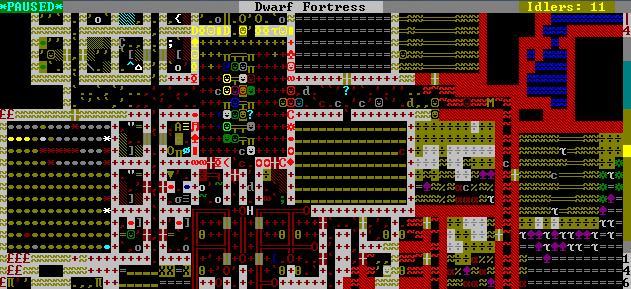
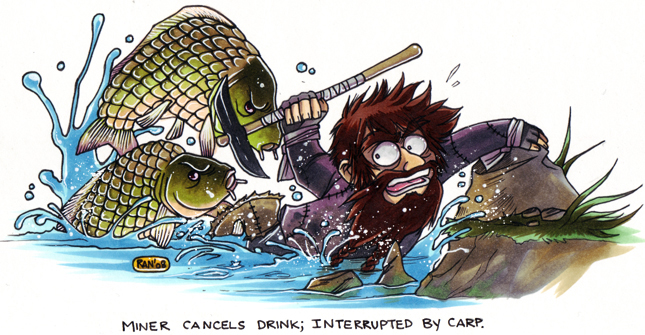
Dwarf Fortress
Then they'll start again, since Losing Is Fun!(TM)
And even though other games (Minecraft, for instance) claim Dwarf Fortress as a major inspiration, they won't achieve the longevity.  Console games die when a new console comes out, and usually far before that.  PC games die more slowly, since tools like DOSBOX and resources like GOG.com exist, but they, too, peaked in popularity when they came out, not fifteen years later.  Any resurgence in old games comes mostly from older players who want to relive the memories of their youth.  Today's twelve-year-olds aren't likely to pick up Zork.

And though Dwarf Fortress isn't going to sway any non-gamers to join the ranks, it will continue to gain popularity with the hardest of the hardcore Sim, RTS, RPG, and Adventure gamers--partly by design.

Part of the reason Dwarf Fortress will last is simply because Tarn won't stop coding anytime soon.  This is the first time (or one of the first times) that a developer lets us take the development journey with them.  Dwarf Fortress is not a complete game, and won't be for twenty years.  At least, that's what Tarn tells us.  People play it now and love it, and don't see anything missing, until the next release, when they jump right into the game to discover the latest improvements and additions.

With other games, when the game comes out, that's the end of the line.  At least, in the old days that was the idea.  Now we've got DLC and always-on MMOs, stretching the lifespan of games into years, rather than simply days, weeks, or (if they're lucky) months.

Yet at some point a newer, flashier game comes out that is similar to the old one, and starts stealing players.  MMOs are still evolving, so when a new one comes out, players migrate, especially if they don't have the cash for monthly subscriptions to multiple games.

Dwarf Fortress doesn't have this problem for two reasons.  First, of course, is that it's free; there's a donation button on their website (bay12games.com), but the game itself has no charge.  Secondly, it's in a class of its own, and there has been nothing that has even attempted to outdo what Dwarf Fortress has done.  There is simply no such thing as a flashier Dwarf Fortress, and their can't be, by definition.

Moar DF
Graphics?  We don't need no stinkin' graphics!
Tarn Adams threw out every principle of modern games when he started making Dwarf Fortress: he made the graphics nothing but ASCII art, and yet the programming behind the gameplay can actually slow down modern computers.  This is the sort of game that looks like it should have been made in the seventies, but couldn't have been.

In that way, it's actually kind of timeless.

Although I think the Adams brothers are geniuses, I am surprised there haven't been any clones.  Of course they would be inferior, but that's never stopped the game industry in the past.

While I think the particular gameplay of Dwarf Fortress won't be matched for some time, I wonder how viable the business end of it is.  Tarn makes a variable and modest living off donations, so it makes me wonder if others could do it too, or if Dwarf Fortress is a fluke.

What I mean is that I wonder if others might make a lifetime-long game, always releasing content, and see how far that gets them.  Even the longest running MMOs dwindle after a time, shut their doors, and lock up, especially when a challenger comes.  But since Dwarf Fortress has no challenger, it lives until Tarn Adams decides to kill it.  Could another game developer do that, and make a living off it?

I guess my main question in all this is:  do videogames have to die?

There are analog games that have had lives much, much longer than the longest running videogame, and I will even excuse outliers like Chess.  But who doesn't have a copy of Monopoly lying around?  It's issued to you when you're born.  Parker Brothers hasn't touched it pretty much since it came out (and I don't count various themed versions as really being any different).  It has no DLC, so to speak, yet even if you hate Monopoly, everyone's got a story about it.

On the other end, Magic: The Gathering is a game with content that comes out practically every day, and it's still a staple of geek culture.

Yet I suspect that Monopoly, Magic, and Dwarf Fortress will still be around twenty years from now, but World of Warcraft won't.  Even though WoW is still going strong, and content is still being released, at some point the payments will dry up, or at least enough to not be able to support the product anymore, and WoW will shut down.  Blizzard, in the meantime, may move on to other products, or even make WoW 2, which will bring WoW a swifter death.

But in any case, the corporate structure of big games seems to suggest that they can't follow the lifelong model of Bay 12 Games.  Despite Dwarf Fortress' small popularity, it is enough for the developer to live off.  A bigger developer wouldn't be able to consider that a success, but a two-man team can.

I wonder if the likes of Dwarf Fortress will bring a rise of ultra-small indies, and connected to it, the rise of lifelong games.

Might more developers take players on the development journey with them?

Is this a natural extension of how games are evolving, or is Dwarf Fortress a one-time fluke?

Tuesday, March 12, 2013

The Art and the Imagination


In most forms of art, the artist has something in their head, and they want you to see it.  You communicate that imagination through your chosen form of media.  Visual artists, from painters to movie-makers, put their imagination into a physical medium.  Of course, if you're a musician, perhaps it's the music itself you're trying to express, not a visual to go with it, so musicians could be considered have an equally concrete medium. 

Blue Man Group playing drums with paint splashing everywhere
In some cases, of course, visuals are part of the musical experience.
But other artists have some level of abstraction, using a medium that doesn't directly use the sense, but rather the imagination of the viewer.  Of course, novelists are the primary example.  When you write, your task is to describe what's in your head so the reader forms the same image in theirs.

Of course, games cross the whole spectrum.  Realistic games with hi-def 3D graphics try to be like a movie, presenting you with the images, while older games, retro games, and abstract games have you use your imagination just as well as reading a book does.  In the case of older games, this was mandatory simply because the technology wasn't there.

But now that developers have a choice of going between realistic and abstract, there is a market to explore the abstract nature of games to their full potential.  This is usually in the realm of indie games, where a retro or abstract visual style is a plus.

There is nothing wrong with either style, and it is simply up to the developers to figure which is best for their game.  Dwarf Fortress is supposed to be ASCII art, while Modern Combat 4 tries its best to be as realistic as possible.  Those two games would not work if their graphical styles were reversed (although that would be a fun experiment).

Adams brothers in ASCII art
Such graphics could come out pretty impressive.  Now to get them at 60 fps.
So the artists of Modern Combat 4 took what was in their imagination and showed it to us.  Tarn Adams tells us that a letter "G" is a goblin, and it's up to us to see it.

When I think of the games in my head, I almost universally see them as the realistic kind--or at least the kind where the imagination of the player doesn't do so much, even if the graphics are cartoony or exaggerated.

Yet, while I can design and code, art has always been the weakest part of my game development skillset.  My head fills with gorgeous panoramas and cinematic set pieces, but I always feel there is no way to display what's in my head to the screen without devoting at minimum months to learning that skillset (and probably years).

But now I think: is that necessary?  Even if my head is filled with amazing pictures, do I need to show that to the player, or can I suggest it, and let them imagine it themselves?

After all, I was a writer before I was a game designer, learning how to get my imagination down on the page for others to replicate.  I never drew pictures and said "Look! This is what should be in your head!"

A child's drawing
And when I did, it took a lot of imagination to see what I meant anyway. (Note: not  actually my drawing.  My art skills are worse.)
So it should go with my own videogames, perhaps.  Why should I spoil the fun of imagining a beautiful scene, when that was the best part to me?

I think the trick is deciding which game idea needs to be represented realistically, and which don't.  As I try to design what the January Engine is for, my head is filled with beautiful scenes that will never be made.  But that's not what the JE is supposed to be about; it's meant to be simple graphics to get the gameplay there.

Art is something I can't control, and so it always seems to me that the thing I want the most is that which is beyond my reach.  The kind of art I want for some of my game ideas would take a team of artists months to create, even if the whole thing could be programmed by myself in half the time.  I get ahead of myself and want more than is warranted for a project.

And without a big team behind me, why should I want to make a huge, epic, graphically impressive game?  That's what the big budget game industry is for, and to be a part of that is what satisfies that itch.

So projects here at Scattergamed, and little things I do by myself, can be my playground, where I can tell you to pretend the pink block is a pig and the green block is a tree.  The games industry can make the movies, while the indies write the novels.

Dwarf Fortress fanart
Besides, fan art is half the fun!