Friday, March 20, 2020

Sewers Under Kasprah – Green Burst & White Backup

Huzzah, more Burst, and more fun stuff to talk about!

Shortsighted Cyclops, Dismantlers, Gremlin Wayfinder, Fungal Armor, Aura Token, Ruinbred Ogre
Click to embiggen
Shortsighted Cyclops and Dismantlers do some basic green things with the Burst. Gremlin Wayfinder has basically no downside to the Burst, since you sacrifice one land to get two (apart from them both going into your hand instead of one on the battlefield). Fungal Armor is really fun to me, providing a duplicate token copy of itself when you Burst. However, the token copy must enchant a second creature; you can't have it enchant the first. (I think there's probably a better way to phrase it.) Ruinbred Ogre is the common Burst payoff.

Moldy Giant, Knotmother, Frog Token, Healer Giant, New Passageways, Leader Basilisk

Moldy Giant is again your basic green effect, as well as Healer Giant, though the eight life is pretty big. Knotmother is the first instance of the frog token, and you can work on going wide with it. New Passageways is a rare Burst payoff, allowing you to find more lands to fuel more Bursts. Leader Basilisk is the first mythic I've shown, which lets you put another creature directly into play. Which, if you like, can be another Burstable creature, and you could sacrifice yet another land for another effect, such as dropping Knotmother. You've just put 10 power on the board for five mana! (...plus two land sacs).

Trained Sniffer, Purger Trainee, Forward Scout, Purgers' Bloodhounds, Inspiriting Call

These common Backup cards are mostly simple, though Inspiriting Call is tricky, and I'd have to aska judge on the rules for it. Do you have to cast it on your begin combat step to activate the Backup? I would think so, because if you cast it during your attack step, the timing for the Backup trigger has already gone by.

Trailing Scout, Watchful Cleric, Steanding Sniffer, Relief Sergeant, Elephant Barricade

Watchful Cleric I find to be particularly interesting, giving other creatures Backup while it's in play. It does not have Backup natively, so you might want to choose to give Watchful Cleric itself Backup. Standing Sniffer is an uncommon Backup payoff. Note something interesting here. Suppose at the beginning of combat Standing Sniffer is untapped, making it a 5/5. You attack with it and something else with Backup. Standing Sniffer becomes tapped, making it a 3/3. Then the Backup trigger goes on the stack. While it's on the stack, Standing Sniffer is vulnerable to be bolted. Watch out!

Relief Sergeant is another uncommon Backup payoff, and, in fact, I considered Backup to be a token-making mechanic initially, such as simply saying as reminder text "When this creature attacks, create a 1/1 soldier creature token". In this case, Relief Sergeant gets the token tapped an attacking, for some solid aggression (however, the token cannot become untapped via Backup in this combat, since the Backup triggers have all already occurred). Elephant Barricade is a rare Backup payoff, though you could potentially just drop it and never attack with it.

Thursday, March 19, 2020

Sewers Under Kasprah – Black Drain & Red Backup

Enliven, Toxinblood Homarid, Glorifier of the Purge, Aging Feeder, Vicious Sweeper
Click to enlarge and read.
The black drain triggers are mostly on death, as one might expect from a deathy color. Glorifier of the Purge has a sacrifice ability on it for when you just need to get through that last point of damage. Vicious Sweeper has a slightly different kind of on-death trigger, letting you drain when it kills another creature. I am considering a Black/White sacrifice Drain deck as an archetype for the next version of this set. Though Black/Red is the usual sacrifice colors, White often allows you to sacrifice creatures for some benefit, such as giving another creature Protection, etc.

Feed from the Shadows, Gnawing Rats, Rat Token, Bloodthirst, Priest of the Purge

Gnawing Rats lets you create rats, so you have a repeatable Drain with each trigger. With black rats and green frogs (we'll see later), I'm considering Black/Green be a possible tokens strategy. The problem here, I think, is that I also do generate a lot of tokens in White with 1/1 soldiers, and I don't want too many token decks. Depending on how silly or serious I make things, perhaps one of those tokens goes away. It would be interesting to almost color-shift all the archetypes, making tokens the Green/Black strategy....

Anyway, Bloodthirst (oops that's a mechanic name) is an uncommon lifegain (and therefore Drain) payoff for black. Priest of the Purge give all of your creatures an on-death Drain trigger. That would certainly work for a tokens deck, wouldn't it... hmm...

Untrained Recruit, Lost Catamount, Fire-Tongued Frog, Feral Outlook, Springing Flailer

Not too much to say about these red Backup cards, apart from they are all very aggressive. Springing Flailer is a Backup payoff that does not have Backup on itself.

Impatient Purger, Purgeball, Crazed Cleaner, Untamed Rage

Impatient Purger is an uncommon payoff for the Instants & Sorceries Izzet deck, though as I've mentioned before I think I'll try to come up with something more interesting for that color combo. Purgeball I just think is a really funny card. If your opponent can find a way to block it with five creatures, it will kill itself. Crazed Cleaner is a bit of a sweeper, or makes a headache for your opponent if it goes unblocked. Untamed Rage is a rare Backup payoff. One of the cycles I made throughout this set is a collection of rare payoff enchantments for each new mechanic.

Wednesday, March 18, 2020

Sewers Under Kasprah – White Plunge & Blue Flush

Our first Legendary creature coming up!

Lose the Way, Hooded Anathema, Blind Condylur
Click to enlarge.
Lose the Way is a fairly benign Plunge effect, similar to Pressure Point but with Plunge instead of 'Draw a card'. Hooded Anathema is similar to the blue Juvenile Feeder from earlier, except that if you get through with Hooded Anathema, you don't assign combat damage. Blind Condylur is a Defender with Plunge on attack, so you can pay mana to have it be able to attack. Overall, I think Hooded Anathema and Blind Condylur are a bit complicated for commons, but not powerful enough to be moved to uncommon or rare territory.

Sanguine Forecast; Terrifying Strike; Spurned Legionnaire; Last Breath, Darkest Survivor

Sanguine Forecast is both a Plunge with a semi-Backup effect. Terrifying Strike is an instant that gives a creature Plunge on damage, but since it also gives doublestrike, it is possible you will be able to double Plunge off of it. Spurned Legionnaire is something of a Mentor of the Meek style effect, but for Plunge rather than card draw, encouraging you to go wide. Last Breath is our first legendary creature for the set. It has three Plunge triggers, and allows you to gain life off the Plunge. Therefore, this lets you Plunge, but it can do its part in lifegain decks as well.

Befuddling Waters, Trudge through Sludge, Trash Dive, Courier Cyclops

Each of the cards above are basic blue spells, with Flush tacked on, as Flush cards tend to be.

Slippery Mutant, Future Sightclops, Interrupted Ploy, Scaturient Sewage

Here we start to get interesting things. The common Flush payoff here gives Slippery Mutant unblockable for the turn. Interrupted Ploy is interesting because it doesn't outright counter a spell, but has a Mana Leak-style effect, except that the opponent has to essentially pay double the cost of the spell to cast it. In all but the most late-game grinds, this should be pretty much a hard counter. The other two cards are again basic blue cards with Flush tacked on. It's tough to make Flush an interesting mechanic worthy of discussion; truly, like Plunge, it offers inevitability and value for control decks more than anything.

Tuesday, March 17, 2020

Sewers Under Kasprah – Red Burst & Green Backup

Burst is such a fun mechanic. There's a massive variety of things to do with it. Here are some ways Red gets to play with Burst.

Tunneler Boa, Hot-Tailed Flailer, Smashing Ogre, Intimidating Ogre
Click to read.
Tunneler Boa lets you trade land for land, which is of course useful for when a player is lacking lands already or is missing a color, but there are a few nonbasic lands in this set you may want to get rid of. Since Tunneler Boa is expensive without the Burst, you may want to sideboard it until you know you need it. Hot-tailed Flailer gives you a nice aggressive 3/1 body while letting you lightning bolt something for the bonus Burst cost. Hot removal! Smashing Ogre lets you come in hot and fast, and if you are Burst-heavy aggressive, a hasty, first-strikey 4/4 might really help close out the game. Intimidating Ogre gives you a threaten effect as well, and while threaten effects aren't always a great option, you're not wasting a card by having a 4/4 for four in your deck, so the threaten effect is a nice bonus.

Terrorizing Crocodile, Junkers, Aggrandizing Druid

Terrorizing Crocodile can similarly close out a game by giving all of your creatures menace when you Burst it onto the scene. Note, however, the Terrorizing Crocodile doesn't have haste, so the 3/3 body shouldn't be relied on to help. Junkers is great for red-style card draw, of course. Aggrandizing Druid practically lets you cast something even bigger for free!

Like Flush, Backup is a relatively simple mechanic, so most cards don't have too much to say about them, part from the extra features and occasional synergies.

Wired, Purging Party, Dwarven Salvager

Wired is an enchantment that grants Backup. Purging Party is a fairly average Backup card, though it's a big boy, since green is the color of big boys. Dwarven Salvager has Backup, and then has Backup for lands, essentially. It's a bit like when Prowess was introduced in Tarkir, where some cards had Prowess, and another ability that would trigger at the same time.

Shrieking Slug, Noisy Lizard, Alarum Sergeant, Minacious Crocodile

Shrieking Slug has a double instance of Backup. Noisy Lizard and Alarum Sergeant have a bonus way to untap all creatures you control, on death and on ETB, respectively. You can kind of see the theme of "waking up" with the titles of these cards. Minacious Crocodile is effectively unblockable, so it's locked away as a rare bomb.

Monday, March 16, 2020

Sewers Under Kasprah – Blue Plunge & Black Flush

Plunge is a control-style mechanic that allows you to slowly mill (sort of) your opponent, while giving you the possibility of powerful scrying.

Eyesore, Sanity Leech, Mind Scavenge, Brain Feeder, Brain Suckle
Click to read.
Eyesore is a simple ETB Plunge trigger. Sanity Leech is repeatable, and being an early defender, it is invaluable to control players looking to stack their deck. Mind Scavenge is a simple instant with Plunge, which has the variability of being better, worse, or equal to Opt. Brain Feeder offers an activated Plunge ability, though I think of it as a tad expensive (for a common, it's important for it to be a little expensive). Brain Suckle essentially lets you "mill" three cards, but you also get your choice of exiling the card with the highest CMC for you to Plunge with.

Juvenile Feeder, Undertow Lurker, Three-Eyed Mole, Pieces of Sanity, Novel Futures

Juvenile Feeder can provide an interesting choice for an opponent. Many times, and opponent who needs to decide blocks may let a simple one damage go through to block other threats, but with the triggered Plunge, the opponent may decide blocking that one damage is important. Undertow Lurker is an Instant/Sorcery payoff, which is naturally Izzet's subtheme. I may change that to be more interesting as I redesign the set. Three-Eyed Mole is a Plunge payoff, letting you constantly draw cards if you have the mana to recast Three-Eyed Mole. Pieces of Sanity is a rare enchantment that gives you a lot of inevitability. Novel Futures is a Scry payoff, but just the same way that all lifegain payoffs are also Drain payoffs, this Scry payoff is also a Plunge payoff.

Flush being a fairly simple mechanic, there won't be too much to talk about on each of these black cards.

Smokebomb, Slippery Injury, Muckwaters, Pile of Bodies

Here, Black gets an instant, a sorcery, an enchantment, and a creature at common each with Flush. The ease of which they enter the graveyard determines their flush cost, so a cheap sorcery like Smokebomb is expensive to Flush, while permanents are a little cheaper.

Agonized Survivor, Rabid-Blood Rebel, Slimesucker, Rotting Feasts

The uncommons and rares get more interesting. Agonized Survivor makes you discard a card to cast, but you get a replacement after you Flush it. Rabid Blood Rebel let you sacrifice itself to act as removal, and also get it more quickly into the graveyard for Flushing. Slimesucker is a simple payoff for Flushing your cards. Rotting Feasts is a more interesting payoff for Flush, in that it turns your Flushing into removal. As well, your opponent hasn't seen the last of Rotting Feasts when they remove it, because you can activate it one last time from your graveyard. They language is a little tricky here, because as an enchantment it only works on other cards while it's on the battlefield, but it works on itself from the graveyard. I wonder if there's a way to clarify that.

Sunday, March 15, 2020

Sewers Under Kasprah – White Drain

Now that I've got my feet wet designing the cards for Sewers Under Kasprah, I'm taking a step back and re-evaluating all the archetypes. The original "archetypes" were just the three color combos that made up a singular mechanic, and that just won't do. So now, with these mechanics in mind, I'm considering proper two-color archetypes that can be supported by these mechanics. So I think I'm going to start from scratch, almost, redesigning the set with the new archetypes in mind. I am also strongly considering changing the story theme and flavor. Though it will remain about sewers, I'm unsure whether I want to alter things to make them more of a joke set as originally intended, or tighten up a story that can flow through the cards.

In the meantime, I thought I'd post all the cards I had originally designed. I'll break them up into a bunch of posts like I did with Seffala, starting today with White Drain cards.

Moral Brutes, Ardent Purger, Dwarven Venger, Anemic Peel, Innervation Sage
Click to read.
First, the common Drain cards. Moral Brutes is a simple card with the basic ETB effect we've all seen from cards like Skymarch Bloodletter. Ardent Purger is similar but requires you to pay the extra mana for the privilege, kind of like Extort. Dwarven Venger has more of an anti-block trigger, so it some ways it acts like Afflict, however since Dwarven Venger needs to have been dealt damage, zero-power creatures (like walls, usually) would not affect it. Anemic Peel is the first sorcery that drains. It uses the 'fairness' aspect of white in its second bit of text, allowing you to catch up to your opponent's life totals. Innervation sage is the common payoff, giving it a Prowess-type boost, but for lifegain.

Longfingers, Sapping Trap, Feasting Leeches, Mucilagious Feaster, Unusual Recruitment, Human Soldier token

Now, the uncommon and rare Drain cards. Longfingers is closer to a proper Afflict mechanic, because its trigger is on becoming blocked, not on being dealt damage. Sapping Trap is a removal spell with a variable Drain tacked on, which can be a very heavy swing if the opponent comes in or blocks with a big bomb. Feasting Leeches is the uncommon payoff for Drain, so at worst if you're below ten life, it's a 1/1, but if you've drained enough to get above 20 life, you're getting an above-rate creature. Mucilaginous Feaster has a bunch of triggers, first by having multiple Drain effects (on ETB and on attack), but then also has half of Dawn of Hope tacked onto it, appending card draw onto lifegain, which makes the card a rare payoff. Unusual Recruitment is a second rare payoff, allowing you to turn your potential lifegain into a go-wide token strategy. Notice here that it's a replacement effect, so you never gain the life. But it's also a may ability so you can choose whether the lifegain or soldiers are more useful at the moment.

Tuesday, February 11, 2020

Sewers Under Kasprah – Ideas, Mechanics, & Themes

My next Magic set I began running with shortly after finishing Ruin of Seffala—that is, shortly after finishing the last card over a year ago.

Ruin of Seffala was meant to be a serious set that I thought I could be proud of. I would say the mishmash of tribal themes was a bit disjointed, and the mechanics were nonbos, such as the original idea of Toughlink (when the creature dies, you gain life equal to its toughness) being completely negated by Wither (as a creature that dies from -1/-1 counters has a Toughness of zero when it dies).

So, having learned that I was bad at "serious" sets, I thought I'd take a break and make something funny.

Since every videogame has a requisite sewer level, I decided to make a sewer-themed Magic set. After hemming and hawing over made up plane (or perhaps city) names, I have settled on Sewers Under Kasprah, or SUK.

Being a sewer theme, I wanted to come up with mechanics that were hilariously named, even if they were seriously designed. I kind of went for a top-down design, coming up with possible mechanic names first that would match a sewer (or rather plumbing) theme, and then tried to come up with mechanics that sounded like they fit the name.

So I'll start by showing off the five major new mechanics I designed. Each mechanic can be found in three colors, but I follow neither wedges nor shards; however, it does all balance out so each color gets exactly three new mechanics. I worked hard to theme them nice!

Naya, the aggro colors, get BACKUP.
Examples of Naya Backup
Click to embiggen. Lots of cards this post!
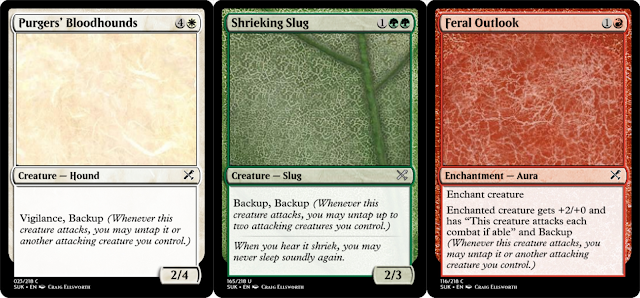
Backup is fairly simple: it's kind of a triggered, moveable Vigilance. Whenever a creature with Backup attacks, you can untap it or any other attacking creature you like. Since the ability goes on the stack (unlike Vigilance), there is an opportunity to react to the trigger.

Since I have my own pseudo-Vigilance, I tried to not use too much real Vigilance. There are a few cases so far, but these are more used like bonuses, such as with Purgers' Bloodhounds here, so that you don't have to 'spend' your Backup trigger on the creature you're attacking with itself. Instances of Backup stack, as you can see with Shrieking Slug, which by itself has two instances of Backup.

Abzan, the colors of life and death, get DRAIN.

Examples of Abzan Drain

Drain is a well-known mechanic that only has this as an unofficial name, so I codified it here. Drain is another simple keyword that can be activated or triggered. When an instance of Drain X occurs, each opponent loses X life and you gain X life. We've seen this ability a million times in Black, and I decided the other colors of lifegain could use them as well. Here are a bunch of options, where you can have it tacked on to an Instant or Sorcery, as an activated ability, or as a triggered ability.

Temur, my favorite colors, get BURST, my favorite mechanic (which will likely always be the case).

Examples of Temur Burst

Burst is more of a reminder word for an ETB effect. Burst always begin with "When this permanent enters the battlefield, you may sacrifice a land. If you do...", and then you get some bonus. I figured Temur would be great for this mechanic: Green is the color of putting extra lands into play; red is the color of short-term gain and high-risk, high-reward; and blue is the color of card draw, so you're likely to hit your land drops. Each instance of Burst always gives a fun different bonus, and depending on your strategy, you may not want to load up on them, or you may decide not to activate the bonus, since it is not mandatory.

Esper, the control colors, get PLUNGE.

Examples of Esper Plunge

Plunge is a keyword ability that kind of mixes and matches what blue and black do best, while inverting the fairness inherent to white. Plunge has you exiling the top card of your opponent's library (a slow mill plan if you wish), and you get to Scry X, where X is the converted mana cost of the exiled card. If you exile a land, bummer, and if you exile your opponent's eight-mana bomb, you get to really stack your deck.

Grixis, the colors of card advantage, get FLUSH.

Examples of Grixis Plunge

Grixis has a very simple mechanic, that mixes the card advantage of red and blue with the graveyard shenanigans of black. You simply pay the Flush cost, exile the flushed card out of your graveyard, and you get to draw a card. The Flush cost usually scales, so the greater the CMC of the card, the smaller the Flush cost. Quite frankly, with its simplicity, I'm surprised there is not another mechanic already just like it (at least not that I could find).

With all of these three-color mechanics designed, I set to work making four-color clans. These are rarely 'tribes' because it's not so much a creature or class tribal set, but just in terms of story, there are five four-color factions.

Above the sewers, in Kasprah, there are gangs duking it out in a post-apocalyptic Seffala-meets-Kaladesh hellscape.

Examples of Survivors

Below the sewers, we have the Survivors. Survivors are primarily intelligent creatures that have gone down into the sewers to escape the war-torn city above and try to live on slime. Survivors are most Homunculi, Mutants, and Orggs. These Survivors are mostly strangely-bred creatures that were raised to do the bidding of one faction or another above, but got away. Survivors make up the 'Artifice' slice of the color pie, meaning White, Blue, Black, and Red. They utilize the new mechanics of Plunge and Flush.

Examples of Purgers

Heading down into the sewers to clean them out are the Purgers, mostly Humans and Dwarfs that form what might be thought of as the police state or armed forces of Kasprah. Their task is to clean out the nuisances of all living creatures in the sewers. I like to picture them as having flamethrowers. They take up the Aggressive colors of White, Black, Red, and Green, and use Backup and Drain as their mechanics.

Examples of Scavengers

The Scavengers are primarily Horrors that live in the sewers, feasting both on the flesh and the psyche of all the enter. Scavengers can be all manner of creatures that would naturally swim in the muck, including Merfolk, Cephalids, Fungi, Homarids, Leeches, Moles, Naga, Ooze, and Rats. Since they feast so well and live like kings in their watery domain, they take up the Growth portion of the color pie: White, Blue, Black, and Green. Their mechanics are Drain and Plunge.

Examples of Beasts

The Beasts (the generic term here, not the creature type) make up the less-than-intelligent creatures that live in the sewers. More beef than brains, these creatures are big boys that chomp their prey to pieces. They can be Crocodiles, Basilisks, Jellyfish, Crabs, Fish, Krakens, Octopi, Frogs, Lizards, Slugs, Snakes, and Squids. I love variety in my beasties. They make up the Altruism slice of the pie (for lack of a better word, since they're generally too dumb for morals), with White, Blue, Red, and Green. Their mechanics are Backup and Burst.
Examples of Rebels

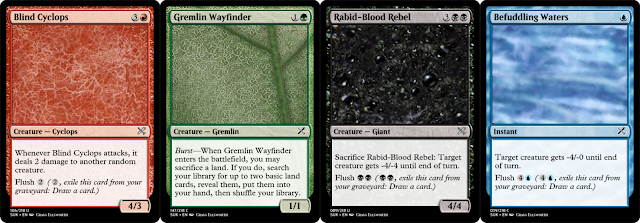
Lastly, we have the Rebels. Above all, these are the guys the Purgers are really going after. The Rebels are the gangs that are going to war above, and use the sewers as ways to get around the city undetected. They've got the waterways mapped out, and even know how to lay traps for their foes. Rebels are mostly monstrous humanoid types, like Giants, Ogres, Orcs, Cyclopi, Minotaurs, and Gremlins. In their quest for destruction and anarchy, they make up the Chaos slice of the pie: Blue, Black, Red and Green. Rebels get the mechanics of Flush and Burst.

Perhaps for story purposes I'll add watermarks to each clan, if I can either find or create good-looking watermarks.

After coming up with all of these mechanics, themes, stories, factions, etc., I blew through a slew of interesting ideas for commons and uncommons, and a few rare and mythics, but I started to slow down and get stuck. Then, out of boredom, I kind of created two-color subthemes for variety, so that there was more focus and differentiation between two colors that might belong in the same wedge or shard. And this is where I'm at: I'm currently experimenting with putting small spins on the overarching themes, like having Blue/Black have a greater emphasis on Mill, and Red/White have a lot of equipment. With Seffala, I stopped myself from making extra cards as soon as I hit the limit, but now I'm experimenting, and I hope to generate far more cards than necessary, and start to cut them back when I have too many (perhaps save some ideas for a sequel). All of the sample cards above have the possibility of being cut or reworked.

But, so far, I am much happier with this effort than my first; though it started off with silly plumbing-themed mechanics, it quickly grew into a serious set with interesting characters. Now I just hope it plays better...